
Blog post from Knowles Precision Devices. Starvoy represents Knowles Precision Devices across Canada, for further information on their range of highly engineered Capacitors and Microwave to Millimeter Wave components for use in critical applications in military, medical, electric vehicle, and 5G market segments.
To protect people and critical equipment, military-grade electronic devices must be designed to function reliably while operating in incredibly harsh environments. Therefore, instead of continuing to use traditional silicon semiconductors, in recent years, electronic device designers have started to use wide band-gap (WBG) materials such as silicon carbide (SiC) to develop the semiconductors required for military device power supplies. In general, WBG materials can operate at much higher voltages, have better thermal characteristics, and can perform switching at much higher frequencies. Therefore, SiC-based semiconductors provide superior performance compared to silicon, including higher power efficiency, higher switching frequency, and higher temperature resistance as shown in Figure 1.
.webp?width=1200&height=627&name=SiC-Based%20Semiconductors%20(1).webp)
As the shift to using SiC-based semiconductors continues, other board-level components, such as capacitors, must change as well. For example, as systems operate at higher frequencies, the capacitance needed decreases, leading to many instances where film capacitors can be replaced by ceramic capacitors.
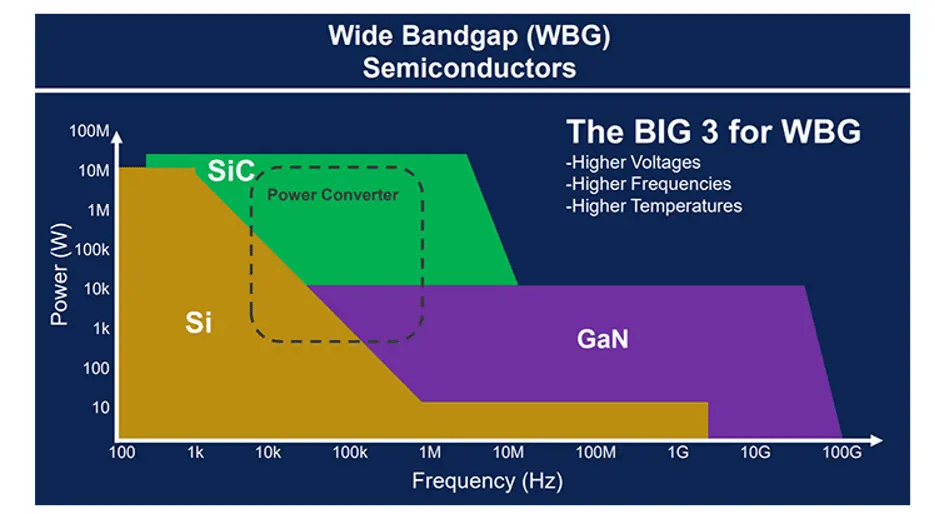
Figure 1. A comparison of traditional silicon semiconductor material to WBG materials such as SiC and GaN. Source.
Why You Need to Use Ceramic Capacitors with Your SiC Semiconductors
In general, ceramic capacitors are small and lightweight, making ceramic capacitors an ideal option for military applications where space and weight are at a premium. When using SiC semiconductors specifically, since the switching speeds are quite fast, high-frequency noise and voltage spikes will occur. Ceramic capacitors are needed to filter out this noise. And for high-frequency power supplies applications, ceramic capacitors are a preferred option because these components have a high self-resonant frequency, low equivalent series resistance (ESR), and high thermal stability.
Knowles Precision Devices: Your Military-Grade Ceramic Capacitor Experts
As a manufacturer of specialty ceramic capacitors, Knowles provide a variety of high-performance, high-reliability capacitors that are well-suited for military applications. At a basic level, they build all of their catalog and custom passive components to MIL-STD-883, a standard that “establishes uniform methods, controls, and procedures for testing microelectronic devices suitable for use within military and aerospace electronic systems.” We also hold the internationally recognized qualification for surface mount ceramic capacitors tested in accordance with the requirements of IECQ-CECC QC32100 as well as a variety of other quality certificates and approvals. For their high-reliability capacitors, they go above and beyond these quality standards and ensure components are burned-in at elevated voltage and temperature levels and are 100 percent electrically inspected to conform to strict performance criteria
Please contact the Starvoy team for further information, or to discuss your requirements.
As new CMIS standards are developed and adopted, with a wide variety of small form factor (SFF) and CMIS specs available, CMIS testing becomes increasingly complex and time consuming. The MultiLane Nexus Analyzer is a direct response to this complexity, designed with speed and simplicity at its core. A CMIS/SFF debug tool for interoperability testing and CMIS/SFF failures, the Nexus Analyzer is equipped with a full feature sweep implemented in its GUI.
Check out the below video from MultiLane, or read more.
Introduction
As a sales representative for ASUS, Starvoy is excited to announce the launch of the Tinker V, the first RISC-V single-board computer (SBC) from ASUS IoT. The Tinker V is designed for industrial IoT applications, with rich connectivity options, reliable technical support, and an open-source architecture. This powerful and versatile SBC is an excellent option for developers looking to build IoT solutions that are efficient, reliable, and built to last. If you’re looking for a powerful and dependable single-board computer for your next IoT project, Starvoy invites you to explore the possibilities of the Tinker V from ASUS. For further information please reach out to our sales team.

Open-Source Architecture
The Tinker V is equipped with a 64-bit RISC-V-based processor, which supports both Linux Debian and Yocto operating systems. This open-source architecture allows for flexibility in deployment and optimization, without incurring licensing and copyright fees.
Rich Connectivity Options
Designed to be compact, the Tinker V offers rich connectivity options and is specially engineered with a broad spread of peripheral connectors for industrial use, including GPIO, micro-USB, dual gigabit Ethernet, a pair of CAN bus interfaces, and two RS232 COM ports.
Built for Industrial IoT
The Tinker V is specially designed for industrial IoT applications, with an ultra-compact size, comprehensive functionality, and rich connectivity options. It also benefits from 1 GB of built-in RAM and an optional 16 GB eMMC, while supporting a wide range of operating temperatures from -20°C to 60°C.
Collaboration with Industry Leaders
ASUS IoT has collaborated with Renesas and Andes to accelerate the adoption of RISC-V and deployment in industrial IoT applications. The Tinker V SBC is specially designed to run Linux Debian and Yocto, making it the perfect choice for diverse IoT and gateway applications.
Conclusion
With its open-source architecture, broad connectivity options, and reliable technical support, the Tinker V is a versatile and reliable SBC for industrial IoT applications. If you are looking for a powerful and dependable single-board computer for your next IoT project, the Tinker V is an excellent option to consider.
For further information on the below, or other ams OSRAM products please reach out to the team.
Smart robots play an increasingly important role in industrial automation as well as in our homes. Smart robotics spans traditional robot arms in production lines (e.g. automotive manufacturers) to mobile robots used in logistics, so-called AGVs (automated guided vehicles), AMRs (autonomous mobile robots) in warehouses, or a robotic vacuum cleaner. ams OSRAM’s miniaturized sensing and illumination solutions. The better the robot understands and interacts with its dynamic environment, the more successful this technology becomes. Beside their unique portfolio of sensors, LEDs and lasers, ams OSRAM pursues a dedicated innovation roadmap regarding future technologies like smart-surface solutions and differentiating algorithms to advance robot capabilities.
Read More›Blog post from Knowles Precision Devices. Starvoy represents Knowles across Canada, for further information please reach out to our sales team.
As electric vehicle (EV) adoption for both consumer and commercial purposes rapidly grows, so does the need for a more widespread, and faster, charging infrastructure. While we’ve seen vast improvements in charging technology in the last few years, as additional regulations on combustion vehicles are implemented and reliance on EVs increases, further EV charging innovations are needed. Currently, wireless charging is the newest EV charging technology evolving.
Read More›Below are some updates from Coherent, a leading provider of test and measurement instruments for optical communications technology, including solutions designed for the Super-C Band.
For further information, feel free to reach out to the Starvoy team to arrange a meeting at our Kanata Test & Measurement Lab, one of our other offices, or whilst we are visiting OFC (6th – 9th March 2023, San Diego).
Introducing WaveShaper® 1000B and 4000B covering the Super C-Band
Coherent introduces the WaveShaper 1000B and 4000B covering the Super C-Band. The 1000B has a 1×1 and the 4000B a 1×4 port configuration. Both units support arbitrary spectral filter shapes of attenuation and phase across the entire operating range from 1523.142 nm to 1573.301 nm. A minimum filter bandwidth of 10 GHz (FWHM) is available. When selecting the “High Resolution” mode – which applies a double pass configuration inside the instrument – the minimum bandwidth reduces to 8 GHz.
Read More›In this industry, it can be easy to take power for granted. Easy, of course, until you don’t have it. Managing that vital resource is critical for systems to operate properly, and in a world that demands smaller, faster and smarter devices, it can be a real challenge. But what if a built-in power management device helped tackle that job? Qorvo’s Configurable Intelligent Power Solutions (ActiveCiPS™) devices help control, monitor and optimize power distribution and conversion in different systems with built-in intelligence and configurability.
In complex systems, or when a designer needs a more advanced or innovative power solution, it can be too expensive to use discrete components. Power Management Integrated Circuits (PMICs) integrate multiple voltage regulators and control circuits into a single chip. Today’s PMICs are flexible, allowing users to update default settings like output voltages, sequencing, fault thresholds and other parameters. As a result, PMICs are used in many small devices such as wearables, hearables and IoT (Internet of Things) devices – all thanks to their small size, high efficiency and low power consumption. These tiny, high-performance PMICs maximize system efficiency and performance while providing design flexibility and lowering the bill-of-materials cost.
Read More›GREENSBORO, NC – February 7, 2022 – Qorvo® (Nasdaq:QRVO), a leading provider of innovative RF solutions that connect the world, announced it has been awarded a $4.1 million follow-on contract with the National Institutes of Health (NIH) through the Rapid Acceleration of Diagnostics (RADxSM) initiative. The contract, awarded to Qorvo Biotechnologies, a wholly owned subsidiary of Qorvo, will help advance the clinical trials and market launch of both a SARS-CoV-2/ Flu Combo Assay and SARS-CoV-2 Antigen Pooling on the Qorvo Omnia™ diagnostic test platform.
The SARS-CoV-2/Flu Combo Assay will simultaneously detect and differentiate between SARS-CoV-2, Flu A and Flu B in an all-in-one test using a single swab sample in approximately 20 minutes. The antigen pooling application will allow up to six samples to be processed together and tested at the same time. Antigen pooling enables significant time and cost savings for screening groups of people who aren’t experiencing SARS-CoV-2 symptoms. Qorvo continues to develop advanced testing formats for SARS-CoV-2 detection in response to the pandemic while focusing on test performance, workflow efficiencies and cost control for end users. Combined with a previous NIH contract award of $24.4 million, this award positions Qorvo to accelerate the production and market launch of multiple COVID testing solutions using a single platform.
Philip Chesley, president of Qorvo Biotechnologies, said, “Today’s COVID testing market is demanding high quality testing infrastructure at the point of care (POC), with automated workflow, menu expansion and scalability to serve future needs of the pandemic. This contract award and continued RADx support enable Qorvo to more effectively address the expanding requirements of diverse end use settings.”
Tiffani Bailey Lash, Ph.D., Co-Program Lead for the RADx Tech program, said, “Qorvo’s antigen test has a lot of potential with near-PCR-level accuracy for use at POC settings.”
The Qorvo Omnia platform represents an innovative diagnostic technique by using high frequency Bulk Acoustic Wave (BAW) sensors to achieve rapid SARS-CoV-2 (COVID-19) antigen test results. BAW sensor technology enables low limit of detection (LOD) levels similar to molecular testing capability.
For more information, visit www.qorvobiotech.com.
This project has been funded in whole or in part with Federal funds from the National Institute of Biomedical Imaging and Bioengineering, National Institutes of Health, Department of Health and Human Services, under Contract No 75N92021C00008.
The Qorvo Omnia SARS-CoV-2 Antigen Test was granted emergency use authorization (EUA) from the U.S. Food and Drug Administration (FDA) in April 2021. The test is authorized for the qualitative detection of nucleocapsid viral antigens from SARS-CoV-2 in nasal swab specimens from individuals who are suspected of having COVID-19 by their healthcare provider within the first 6 days of symptom onset. The Qorvo Omnia SARS-CoV-2 Antigen Test has not been FDA cleared or approved. It has been authorized by the FDA under an Emergency Use Authorization and testing is limited to laboratories certified under the Clinical Laboratory Improvement Amendments of 1988 (CLIA), 42 U.S.C. §263a, to perform moderate or high complexity tests. This test has been authorized only for the detection of proteins from SARS-CoV-2, not for any other viruses or pathogens. These tests are only authorized for the duration of the declaration that circumstances exist justifying the authorization of emergency use of in vitro diagnostic tests for detection and/or diagnosis of COVID-19 under Section 564(b)(1) of the Act, 21 U.S.C. § 360bbb-3(b)(1), unless the authorization is terminated or revoked sooner.
About Qorvo Biotechnologies
Qorvo Biotechnologies, LLC is a wholly owned subsidiary of Qorvo, Inc. focused on the development of point-of-care (POC) diagnostics solutions leveraging Qorvo’s innovative BAW sensor technology.
About Qorvo
Qorvo (Nasdaq: QRVO) makes a better world possible by providing innovative Radio Frequency (RF) solutions at the center of connectivity. We combine product and technology leadership, systems-level expertise and global manufacturing scale to quickly solve our customers’ most complex technical challenges. Qorvo serves diverse high-growth segments of large global markets, including advanced wireless devices, wired and wireless networks and defense radar and communications. We also leverage unique competitive strengths to advance 5G networks, cloud computing, the Internet of Things, and other emerging applications that expand the global framework interconnecting people, places and things. Visit www.qorvo.com to learn how Qorvo connects the world.
Qorvo is a registered trademark of Qorvo, Inc. in the U.S. and in other countries. All other trademarks are the property of their respective owners.
| Media Contact: Brent Dietz Qorvo Director of Corporate Communications +1 336-678-7935 brent.dietz@qorvo.com |
This press release includes “forward-looking statements” within the meaning of the safe harbor provisions of the Private Securities Litigation Reform Act of 1995. These forward-looking statements include, but are not limited to, statements about our plans, objectives, representations and contentions, and are not historical facts and typically are identified by use of terms such as “may,” “will,” “should,” “could,” “expect,” “plan,” “anticipate,” “believe,” “estimate,” “predict,” “potential,” “continue” and similar words, although some forward-looking statements are expressed differently. You should be aware that the forward-looking statements included herein represent management’s current judgment and expectations, but our actual results, events and performance could differ materially from those expressed or implied by forward-looking statements. We do not intend to update any of these forward-looking statements or publicly announce the results of any revisions to these forward-looking statements, other than as is required under U.S. federal securities laws. Our business is subject to numerous risks and uncertainties, including those relating to fluctuations in our operating results; our substantial dependence on developing new products and achieving design wins; our dependence on several large customers for a substantial portion of our revenue; the COVID-19 pandemic materially and adversely affecting our financial condition and results of operations; a loss of revenue if defense and aerospace contracts are canceled or delayed; our dependence on third parties; risks related to sales through distributors; risks associated with the operation of our manufacturing facilities; business disruptions; poor manufacturing yields; increased inventory risks and costs due to timing of customer forecasts; our inability to effectively manage or maintain evolving relationships with platform providers; our ability to continue to innovate in a very competitive industry; underutilization of manufacturing facilities as a result of industry overcapacity; unfavorable changes in interest rates, pricing of certain precious metals, utility rates and foreign currency exchange rates; our acquisitions and other strategic investments failing to achieve financial or strategic objectives; our ability to attract, retain and motivate key employees; warranty claims, product recalls and product liability; changes in our effective tax rate; changes in the favorable tax status of certain of our subsidiaries; enactment of international or domestic tax legislation, or changes in regulatory guidance; risks associated with environmental, health and safety regulations and climate change; risks from international sales and operations; economic regulation in China; changes in government trade policies, including imposition of tariffs and export restrictions; we may not be able to generate sufficient cash to service all of our debt; restrictions imposed by the agreements governing our debt; our reliance on our intellectual property portfolio; claims of infringement of third-party intellectual property rights; security breaches and other similar disruptions compromising our information; theft, loss or misuse of personal data by or about our employees, customers or third parties; provisions in our governing documents and Delaware law may discourage takeovers and business combinations that our stockholders might consider to be in their best interests; and volatility in the price of our common stock. These and other risks and uncertainties, which are described in more detail in Qorvo’s most recent Annual Report on Form 10-K and in other reports and statements filed with the Securities and Exchange Commission, could cause actual results and developments to be materially different from those expressed or implied by any of these forward-looking statements.

Original blog post from: https://www.qorvo.com/design-hub/blog/boosting-bandwidth-to-future-proof-catv-solutions
Future entertainment systems and work-at-home environments are rapidly moving toward greater two-way interaction, which calls for enhanced downstream bandwidth and upstream capabilities. To stay competitive in the evolving CATV business, innovative technologies are needed to keep up with demands. One component that can play a vital role in this evolution is the CATV amplifier based on gallium nitride (GaN) technology. This post provides insight into how to do just that. The following is an excerpt from a Qorvo white paper, How to Increase Downstream Bandwidth and Upstream Capabilities in CATV Amplifiers with Greater Efficiency.
Meeting Higher Uplink Bandwidth Demands
Typical allocations for upstream traffic on Hybrid Fiber Coax (HFC) networks in the US range from 5 MHz to 42 MHz. User activities and new use cases are driving the need for increased capacity. In response, some multiple system operators (MSOs) are setting mid-splits or high-splits within the available bandwidth to accommodate these demands, reducing downstream bandwidth and possibly curtailing content or services.
MSOs facing this challenge are exploring the options available through DOCSIS 3.1 or DOCSIS 4.0 specifications. Upstream capacity within DOCSIS 3.1 can be extended up to 204MHz. While DOCSIS 4.0 allows the upstream to go up to 684MHz in both full duplex (FDX) and extended spectrum DOCSIS (ESD). Figure 1 shows how full duplex (FDX) let upstream and downstream traffic share the 684 MHz frequency range.
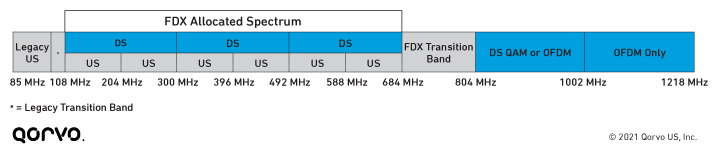
Figure 1. DOCSIS 4.0 FDX spectrum for upstream (US) and downstream (DS).
Maintaining Linearity
The trend toward extended CATV bandwidth has led engineers and system architects to explore new technologies as networks are upgraded, requiring a newer generation of passive and active products. To meet demands for the increased bandwidth and data rates, CATV amplifiers must maintain a higher linear output power.
Gallium Nitride (GaN) devices can deliver more than the necessary efficiency and performance to satisfy DOCSIS requirements for CATV amplifiers. Consistent linearity is a primary requirement for reliable data transmission and signal integrity across HFC networks. The nonlinear behavior of active power devices can degrade the signal quality, leading to bit errors on digital channels and sometimes complete failure when trying to demodulate the signal.
Linearity of a gain block or amplifier depends primarily on these factors:
- Semiconductor technology
- Circuit design
- Power consumption
- Thermal design
A high degree of linearity and efficiency are paramount when designing an HFC amplifier, and this is where GaN-based components have a clear advantage. Figure 2 shows the fundamental components of a CATV amplifier. In terms of linear output, the downstream performance of an HFC amplifier or node largely relies on the output stage gain block (also called the power doubler).
What is DOCSIS?
Data Over Cable Service Interface Specification (DOCSIS) is an international telecommunications standard that permits the addition of high-bandwidth data transfer to an existing cable television (CATV) system. It is used by many cable television operators to provide Internet access over their existing hybrid fiber-coaxial (HFC) infrastructure. The version numbers are sometimes prefixed with simply “D” instead of “DOCSIS” (e.g., D3 for DOCSIS 3).
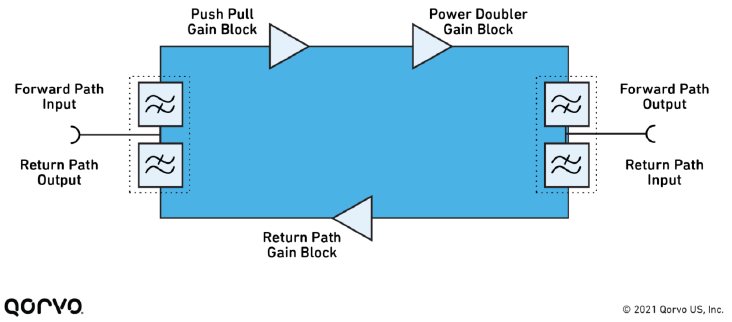
Figure 2. Block diagram of a CATV amplifier.
GaN represents an enabling technology for power amplifier designs that can accommodate the demands of the DOCSIS 3.1 and DOCSIS 4.0 standards. Figure 3 illustrates a design stage that originally implemented the gain block architecture using field-effect transistors (FETs) based on GaAs technology. Replacing FET3 and FET4 with GaN-based components results in a substantial performance improvement because of the characteristics of these devices, including operation at high frequencies, high-voltage ruggedness, high current density, and power handling. GaN supports up to 10 W/mm compared to 1 W/mm for GaAs.
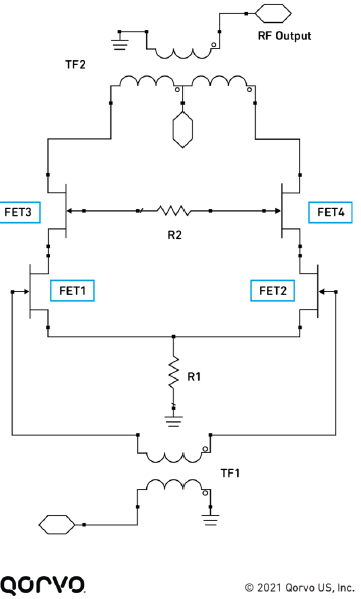
Figure 3. Gain block architecture improved through the use of GaN-based FETs.
Comparing the relative characteristics of material technologies used in CATV gain-block architecture, Figure 4 shows the advantages of GaN technology, enabling MSOs to boost linear output while maintaining existing amplifier spacing. This can minimize upgrade costs and make it possible to implement fiber deep solutions, locating fiber closer to the customer to enhance service and at the same time reducing or eliminating amplifiers.
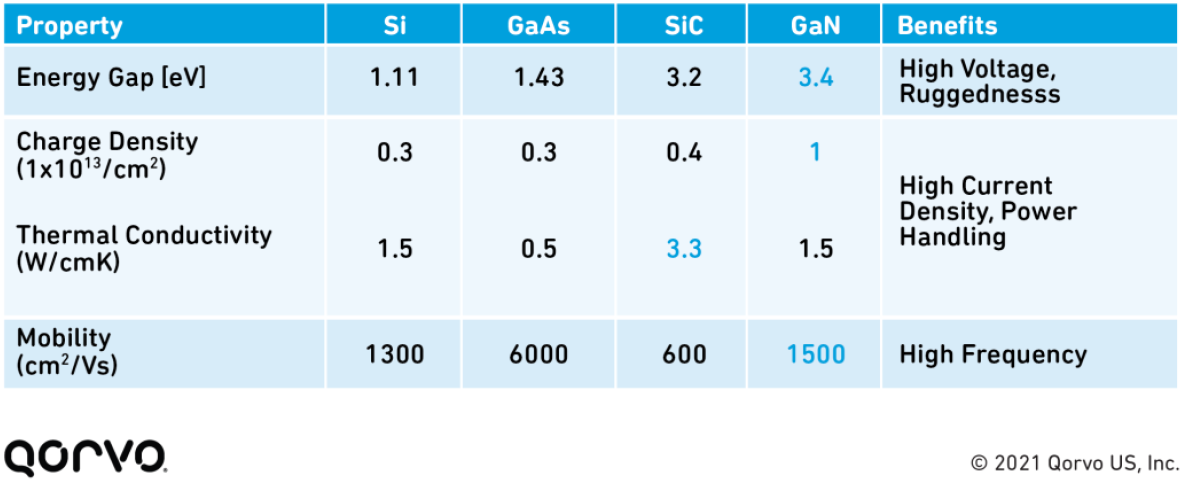
Figure 4. Characteristics of GaN-based components compared to other options.
Qorvo Expertise in CATV Gain Blocks
Two Qorvo products are outstanding design choices in this sector:
- QPA3260 power doubler hybrid – Delivers the highest linear output up to 1.2 GHz
- QPA3315 power doubler hybrid – Supports DOCSIS 4.0 implementations in designs requiring up to 1.8 GHz capabilities
With the need for greater downstream bandwidth and increased upstream capacities spurred by DOCSIS 3.1 and DOCSIS4.0 standards, Qorvo can help MSOs respond to the challenge with GaN-based gain blocks for CATV signal amplification. CATV equipment manufacturers can rely on proven solutions that deliver better data transport using durable and reliable components.
Have another topic that you would like Qorvo experts to cover? Email your suggestions to the Qorvo Blog team and it could be featured in an upcoming post. Please include your contact information in the body of the email.